


Know Your Bands, Train Your Watch
S-band and X-band aren’t interchangeable settings — they’re two different tools for two different threats off your bow. This closes our three-part series with the one skill every OOW must be able to demonstrate, not just describe.
A checklist tick doesn’t prove a watchkeeper understands band selection. A live demonstration does.
Over the last two posts in this series we looked at radar as a discipline of habit — of standing a proper watch, of not letting a quiet bridge become a complacent one. This final post narrows the focus to something more specific and, frankly, more testable: does your OOW actually know when to reach for S-band, and when X-band is the only set that will show what’s really in the water ahead?
01 Two Bands, Two Jobs
Every OOW can recite that a ship carries two radars. Far fewer can explain, under questioning, why — or demonstrate switching between them at the right moment for the right reason. That gap is where risk lives.
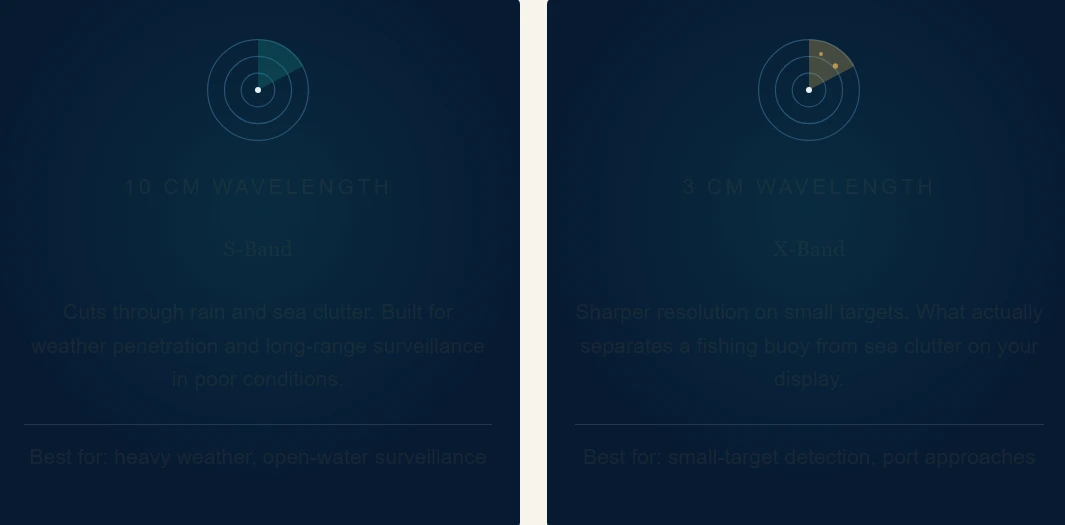
Why it matters: the wrong band at the wrong moment doesn’t just cost you resolution — it costs you the target. A FAD, a rumpon, a fishing buoy, or a small craft can sit below the noise floor of a radar set poorly matched to the conditions. That’s not a training footnote. That’s a near-miss waiting to happen.
02 From Trivia to Practical Competence
Knowing when to use which band isn’t trivia to be recited in a classroom. It’s what keeps a fishing net off your propeller and a small craft off your bow. Recent close-quarters situations involving FADs and rumpons in high-density fishing waters have reinforced exactly this point across the fleet — the failure wasn’t a lack of radar, it was a lack of applied band discipline at the moment it mattered.
Radar watch discipline is a competence, not a
compliance box.
03 To Auditors and DPAs
For Practical Assessment
This belongs in every OOW practical assessment, not just a paperwork check. Asking a watchkeeper to define S-band and X-band from memory tells you they can memorise a manual. Asking them to demonstrate a band switch in a simulated fog-to-clutter scenario, and explain their reasoning as they do it, tells you they can keep a ship safe.
Build it into your SIRE 2.0-aligned OOW assessments as a live, scenario-based task — not a tick against a question bank. Pair it with a Night Order entry requirement, so the standard travels from the bridge to the record and back again.
This belongs in every OOW practical assessment, not just a paperwork check. Asking a watchkeeper to define S-band and X-band from memory tells you they can memorise a manual. Asking them to demonstrate a band switch in a simulated fog-to-clutter scenario, and explain their reasoning as they do it, tells you they can keep a ship safe.
Build it into your SIRE 2.0-aligned OOW assessments as a live, scenario-based task — not a tick against a question bank. Pair it with a Night Order entry requirement, so the standard travels from the bridge to the record and back again.
04 Train It, Test It, Write It Down
The discipline this series has argued for — across all three posts — comes down to the same principle applied at three different points: a properly stood watch, a habit of vigilance that doesn’t erode with a quiet night, and now, the technical judgement to choose the right tool for what’s actually out there in the dark or the rain.
None of it holds without documentation. Train it in the classroom and on the simulator. Test it on the bridge, under an assessor’s eye. Then put it in writing in the Night Orders, so the standard doesn’t depend on memory alone — it depends on a record every relieving watchkeeper can read.
None of it holds without documentation. Train it in the classroom and on the simulator. Test it on the bridge, under an assessor’s eye. Then put it in writing in the Night Orders, so the standard doesn’t depend on memory alone — it depends on a record every relieving watchkeeper can read.
Reference: PSS Circular NAV-1/2026 — Radar Standby & Small-Target Watch Procedures.