

Pioneer Maritime Training Institute
Major Non-Conformity, Non-Conformity or Observation? Getting Audit Findings Right
A clear guide to what each finding means, how to classify it, and what happens next
Every audit ends with findings, and how a finding is worded and classified decides what the company does next. Misclassify it and you either bury a serious problem or trigger needless alarm. Whether you audit under the ISM Code, ISPS Code, MLC 2006 or ISO 9001, 14001, 45001 and 50001, three terms come up again and again: Major Non-Conformity, Non-Conformity and Observation.
.
First, what is objective evidence?
No finding is valid without it. Objective evidence is information that can be verified, gathered by observation, measurement, test, records or interviews. “The pump looks neglected” is an opinion. “The emergency fire pump failed to start on test at 10:20 and the maintenance record shows no test for 14 weeks” is objective evidence.
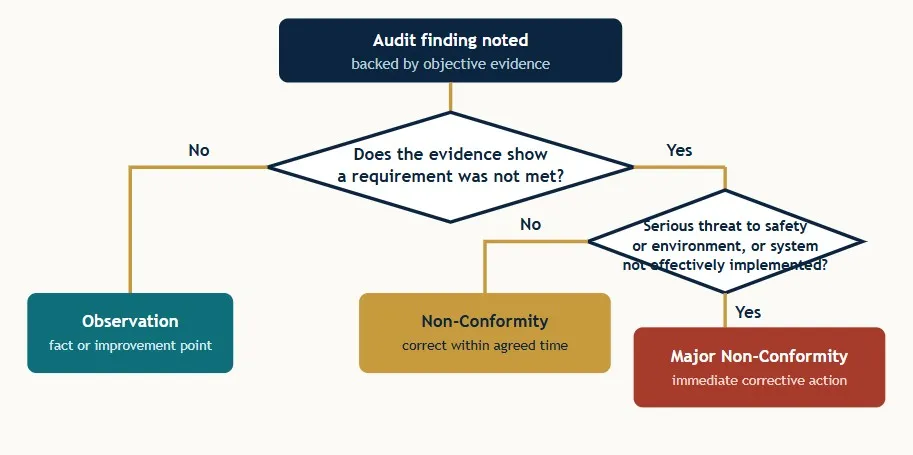
A simple way to decide how to classify a finding .
.
The three definitions
Major Non-Conformity
Under the ISM Code, a major non-conformity is an identifiable deviation that poses a serious threat to the safety of personnel or the ship, or a serious risk to the environment, and needs immediate corrective action. It also covers a lack of effective and systematic implementation of the Code’s requirements.
In ISO certification audits, a major non-conformity is one that affects the management system’s ability to achieve its intended results, or that casts significant doubt that a process is under control. Several minor non-conformities against the same requirement can add up to a major one when they point to a systemic failure.
Non-Conformity (minor)
An observed situation where objective evidence shows that a specified requirement has not been fulfilled. The requirement may come from a code, a regulation, an ISO standard, or the company’s own procedures. It is a real gap, but it does not on its own threaten safety or the environment seriously, and the system as a whole still works.
An observed situation where objective evidence shows that a specified requirement has not been fulfilled. The requirement may come from a code, a regulation, an ISO standard, or the company’s own procedures. It is a real gap, but it does not on its own threaten safety or the environment seriously, and the system as a whole still works.
Observation
Under the ISM Code, an observation is a statement of fact made during an audit and supported by objective evidence. It is not a failure to meet a requirement. In practice, auditors also use observations to flag situations that could become a non-conformity if left alone, or to suggest an opportunity for improvement or note good practice.
Under the ISM Code, an observation is a statement of fact made during an audit and supported by objective evidence. It is not a failure to meet a requirement. In practice, auditors also use observations to flag situations that could become a non-conformity if left alone, or to suggest an opportunity for improvement or note good practice.

.
Side by side
| Major NC | Non-Conformity | Observation | |
|---|---|---|---|
| Requirement breached? | Yes | Yes | No |
| Impact | Serious threat to safety or environment, or system failure | Isolated lapse; system still effective | None yet, or a point to improve |
| Response | Immediate corrective action; verification, often by an additional audit | Root cause, correction and corrective action within an agreed time | Considered by management; no formal closure needed |
| Certificate risk | DOC/SMC or ISO certificate may be withheld, suspended or withdrawn | Normally none if closed on time | None |
.
Major NC
Non-Conformity
Observation
Requirement breached?
Impact
Response
Certificate risk
Impact
Response
Certificate risk
Yes
Serious threat to safety or environment, or system failure
Immediate corrective action; verification, often by an additional audit
DOC/SMC or ISO certificate may be withheld, suspended or withdrawn
Serious threat to safety or environment, or system failure
Immediate corrective action; verification, often by an additional audit
DOC/SMC or ISO certificate may be withheld, suspended or withdrawn
Yes
Isolated lapse; system still effective
Root cause, correction and corrective action within an agreed time
Normally none if closed on time
Isolated lapse; system still effective
Root cause, correction and corrective action within an agreed time
Normally none if closed on time
No
None yet, or a point to improve
Considered by management; no formal closure needed
None
None yet, or a point to improve
Considered by management; no formal closure needed
None
Closure time limits differ between flag states, recognised organisations and certification bodies, so always check the applicable rules.
.
Examples from the field
Major NC
- Enclosed space entry carried out with no permit, no gas test and no standby, and crew unaware of the procedure
- Critical lifesaving or firefighting equipment inoperative, with no compensating measures
- Many unresolved non-conformities on one SMS element, showing the process has broken down
Non-Conformity
- One monthly drill missing from the records
- A calibration certificate for a gas detector expired, with a valid spare on board
- >A checklist not signed off on one occasion
Observationy
- Near-miss reporting is low compared with fleet trend
- A procedure is correct but hard to follow; clearer wording would help
- A crew-initiated safety practice worth sharing fleet-wide
.
How to write a finding that stands up
A good finding is short, factual and traceable. Give the requirement (clause or procedure), the objective evidence (what, where, when, who confirmed) and the statement of the gap. Avoid opinions, blame and vague words such as “poor” or “inadequate”.
Example: “Procedure SMS 7.2 requires monthly testing of the emergency generator. The records for March and April show no test, confirmed by the Chief Engineer during interview on 12 May.”
.
What happens after the finding

For a major non-conformity, the first step cannot wait. The risk must be controlled straight away, and the auditor or authority then verifies the fix, often on board or through a follow-up audit.
.
Common mistakes
- Over-grading: calling a paperwork slip “major” and weakening trust in the process.
- Under-grading: logging a systemic failure as a one-off to keep the report clean.
- Findings without evidence: opinions that cannot be defended at closure.
- Treating symptoms: fixing the record, not the root cause, so the same finding returns.
- Ignoring observations: today’s observation is often next year’s non-conformity.
Learn to grade findings with confidence
Classifying findings correctly is a core skill of every maritime internal auditor. At Pioneer Maritime Training Institute, our Integrated Management System Internal Auditor programme teaches evidence gathering, finding classification, non-conformity reporting, root cause analysis and corrective action verification, with practical maritime case studies across the ISM Code, ISPS Code, MLC 2006 and ISO 9001, 14001, 45001 and 50001.
Build the skills that make your audits credible, fair and effective.
Build the skills that make your audits credible, fair and effective.