


Radar on Standby, Nets Invisible
traffic that matters most.
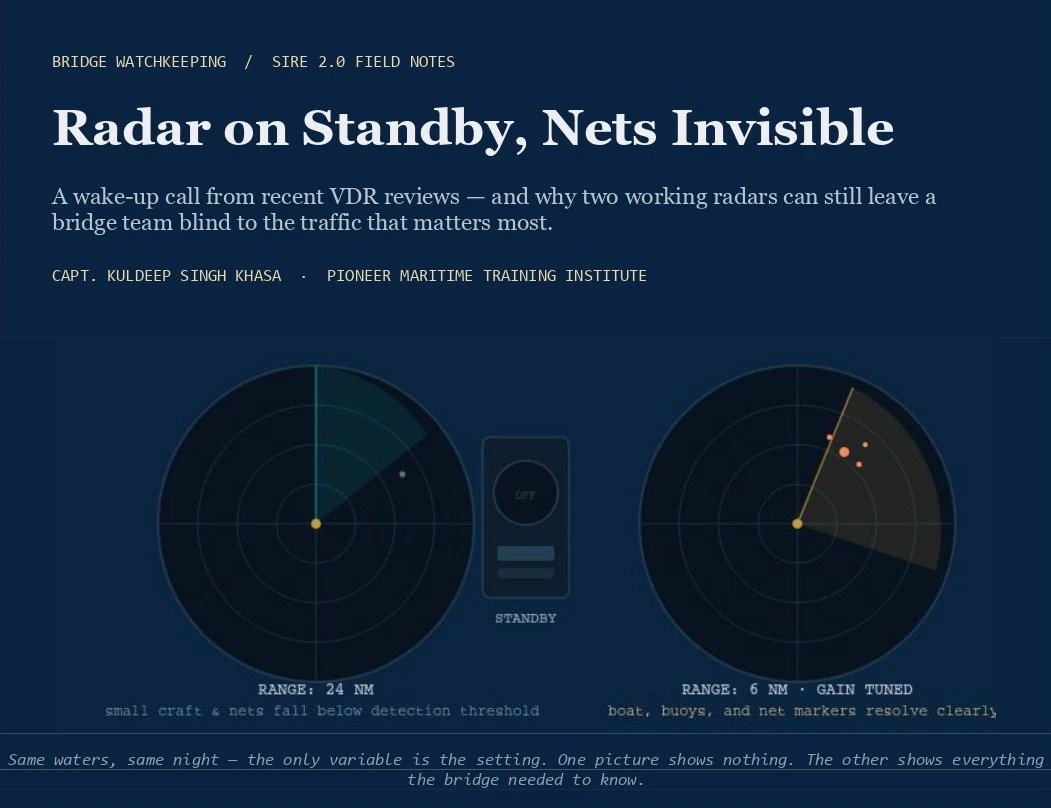
That distinction matters more than it might first appear. An isolated error is forgivable; a habit is a system failure waiting for its moment. When a habit like this takes root, it survives because nothing bad has happened yet — until the one transit where a fishing boat with no AIS, no lights, and no radar reflector drifts directly into the ship’s path in the dead of night. At that point, the SMS manual’s carefully worded clause on maintaining a continuous and effective lookout becomes irrelevant paperwork. The manual does not steer the ship. The radar picture does. And if that picture has been quietly degraded by a range setting chosen for comfort rather than for the actual traffic density outside the bridge windows, the ship is now navigating on faith, not information.
It is worth being precise about why this specific combination is so dangerous. A single radar on a long range, even at 24 NM, will still register large targets: other merchant vessels, coastlines, weather cells. What it will not reliably show is a low-freeboard wooden fishing boat, a string of unlit buoys marking a net, or a raft of Fish Aggregating Devices sitting low in the water. These targets need short-range clutter management, tighter gain settings, and a second radar actively cross-referencing the picture — not a companion set sitting idle on standby because “the other one is covering it.” In genuinely fishing-dense waters, that second radar should be doing exactly the opposite job: short range, tuned for small, low, close-in returns, run in parallel with the long-range set rather than switched off in its shadow.
The uncomfortable truth this pattern exposes is cultural, not technical. Every vessel in these VDR reviews had two functioning radars, a documented lookout procedure, and — in almost every case — officers who could recite the collision regulations on request. The gap was never knowledge. It was practice under pressure: fatigue, a quiet night, a false sense of security built from a hundred uneventful transits, and a slow erosion of the discipline that says both radars stay actively tuned to the actual traffic around the vessel, not to whatever range feels least demanding to monitor. This is exactly the kind of gap that behavioural competency assessment is designed to surface, because it does not show up in a knowledge test — it shows up in what an officer actually does at 0300 when nobody is watching except the VDR.
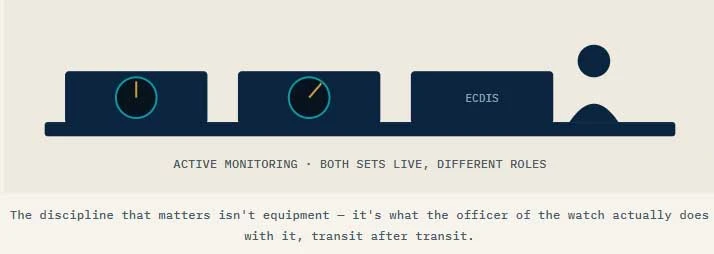
So what should change, practically, on the next transit through waters known for fishing traffic? Both radars should be live, and deliberately differentiated in role — one holding a longer range for overall traffic awareness, the other set short and clutter-optimized specifically to pick up small, low, close targets. Range and gain settings should be a standing agenda item during pre-arrival and watch handover briefings, not an afterthought. And officers should be trained to treat “we haven’t hit anything yet” as the weakest possible evidence that the current setup is safe — because the fishing boat that finally does appear in the ship’s path will not radio ahead to say it is coming. The radar picture is the only warning the bridge will get, and it is only as good as the settings chosen to build it.