Pioneer Group

Unit No - 942, Tower B2, Spaze I-Tech Park, Sohna Road, Gurgaon

Blog

Home / Blogs / The Fix

Blog

Home / Blogs / Real Audits, Real Skills

The Fix Isn't Complicated - It's Discipline.

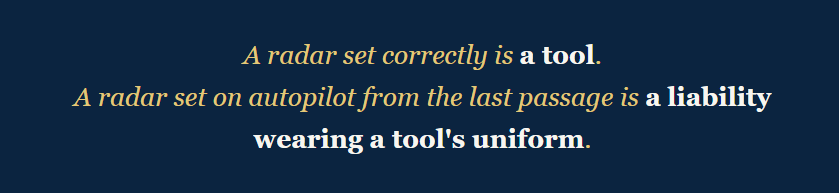
A parked radar and a wide-open range scale aren’t equipment failures.
They’re habits — and habits are the one thing a bridge team can fix without waiting on a budget line.

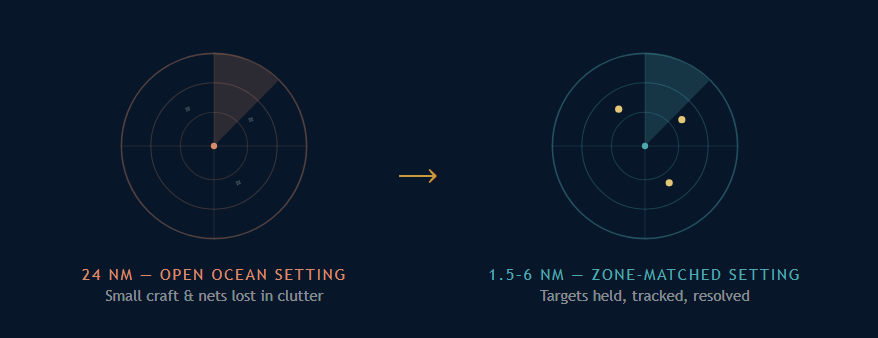
In the first post of this series, we looked at a pattern turning up across VDR reviews: vessels transiting fishing-dense waters with one radar parked on standby and the other set to 24 nautical miles — wide enough to make small craft and nets disappear from the screen entirely. That post asked the uncomfortable question. This one answers it.

The good news is that closing this gap doesn’t require new hardware, a system upgrade, or a procurement request. It requires three specific, checkable habits — the kind that a Master can write into standing orders this week and an OOW can be held to on every watch after.

Same radar, same crew, same waters — the only variable is the range scale the watch actually selects.

Three habits, not one policy document

None of the following is complicated in isolation. What makes the difference is treating all three as non-negotiable, every watch, in every fishing-dense transit — not as guidance to be applied when someone remembers.
Both radars operational — never one in reserve
In high-traffic or fishing-dense zones, both radar sets should be running, not one parked on standby “in case the other fails.” Redundancy is only redundancy if both systems are actually contributing to the picture in real time. A radar on standby is a radar doing nothing for the watch that needs it most.
Range scales matched to reality, not habit
1.5, 3, or 6 nautical miles in dense fishing grounds — not the open-ocean range carried over from the previous leg because nobody reset it. A wide range scale is correct for open water and actively dangerous in a fishing ground, where the targets that matter are small, low, and close.
Range scales specified in the Master’s Night Orders
This is the habit that makes the other two stick. Required range scales per zone belong in writing, in the Night Orders — not left to individual judgement or guesswork at 0300 when the OOW is tired, the traffic is unfamiliar, and there’s no one to ask.

Why this belongs to the Master, not the OOW alone

Leaving range-scale discipline to individual judgement puts an unfair burden on whoever happens to be on watch when the ship enters a fishing ground. Writing it into the Night Orders removes that burden — it turns a judgement call into a standing instruction, and a standing instruction is something SIRE 2.0 assessors, auditors, and the next watch officer can all verify against the same standard. That’s the real shift this fix asks for: not better equipment, but a bridge team that treats radar configuration as seriously as it treats course and speed — because in fishing-dense waters, it’s just as much a collision-avoidance decision.