

Pioneer Maritime Training Institute
Why Every Maritime Professional Should Complete an Integrated Management System (IMS) Internal Auditor Course
Beyond ISM, ISPS & MLC – why ISO standards matter in today’s maritime industry
The maritime industry has evolved significantly over the past decade. Compliance with the ISM Code, ISPS Code and MLC 2006 remains mandatory for every shipping company. But ship owners, managers, offshore operators, ports, terminals, shipyards and maritime service providers are also adopting internationally recognised ISO management systems. They want better operational performance, lower risk, and visible commitment to quality, environmental protection, occupational health & safety, and energy efficiency.
This has driven the growth of the Integrated Management System (IMS), which combines four standards:
This has driven the growth of the Integrated Management System (IMS), which combines four standards:
- ISO 9001:2015 – Quality Management System (QMS)
- ISO 14001:2015 – Environmental Management System (EMS)
- ISO 45001:2018 – Occupational Health & Safety Management System (OH&S)
- ISO 50001:2018 – Energy Management System (EnMS)
An Internal Auditor trained in both maritime codes and ISO standards has a clear competitive advantage in today’s shipping industry.
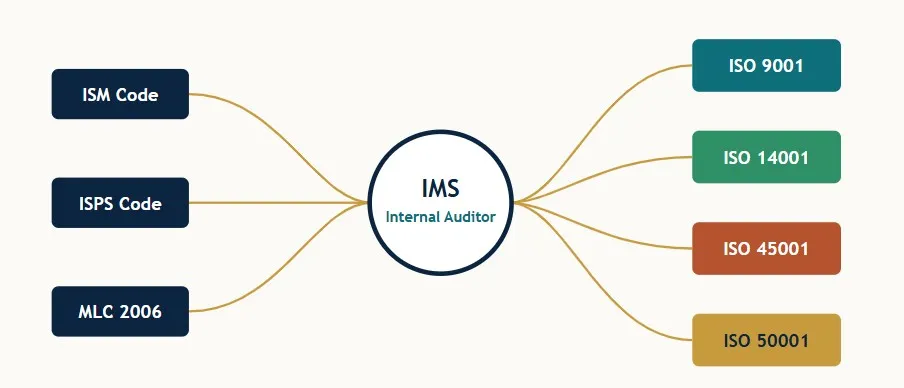
Maritime codes and ISO standards, audited as one integrated system.
.
Why the ISM Code alone is no longer enough
The ISM Code sets the framework for safe ship operation and pollution prevention. It does not comprehensively cover many management areas that modern shipping companies are expected to handle:
- Customer satisfaction
- Business process improvement
- Organisational performance measurement
- Occupational health management
- Energy efficiency management
- Climate change initiatives
- Continuous quality improvement
- Integrated risk management across departments
ISO management systems complement the ISM Code with internationally recognised best practice for running an organisation effectively.
.
Benefits of an Integrated Management System
Instead of maintaining separate systems for quality, environment, safety and energy, an organisation integrates them into one.
- Single integrated audit. One audit covers multiple standards at once, reducing duplicated work.
- Improved operational efficiency. Common procedures, documentation and responsibilities cut administrative workload.
- Better risk management. Safety, quality, environmental and energy risks are managed together, not in silos.
- Stronger regulatory compliance. Supports IMO requirements, Flag State regulations, customer expectations and ISO certification.
- Reduced costs. Fewer audits, fewer duplicated procedures, less paperwork and better use of resources.
- Improved business reputation. ISO-certified organisations are often preferred by charterers, oil majors, offshore operators and international clients.
- Continual improvement. Management reviews, internal audits and performance indicators drive steady progress.
.
Understanding each ISO standard
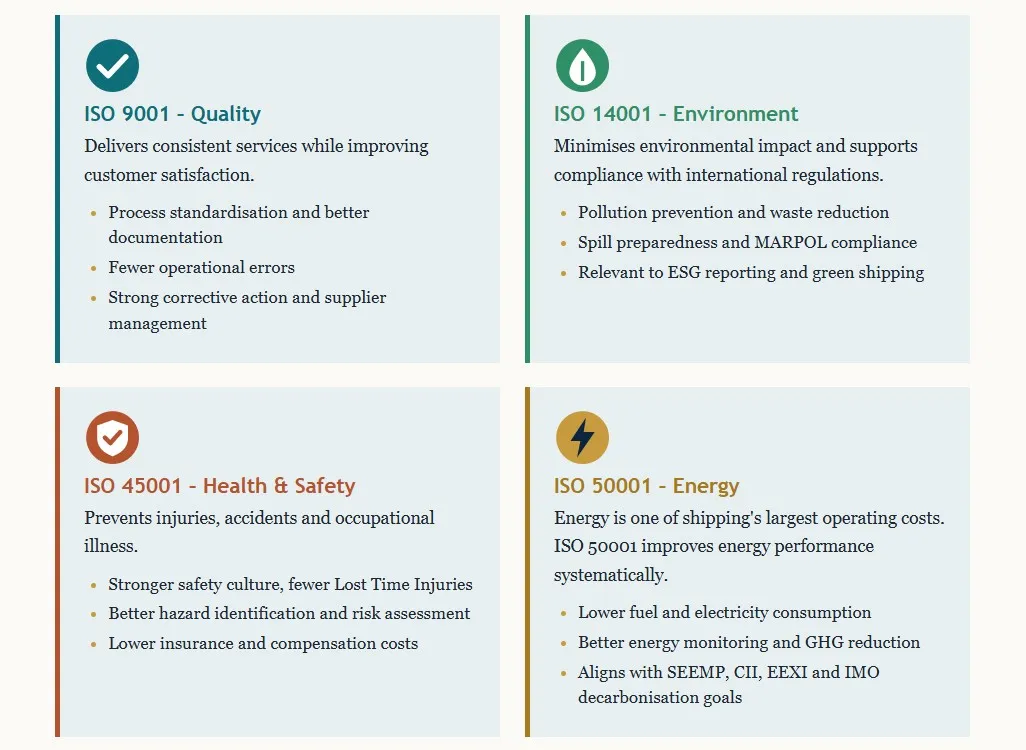
ISO 9001 – Quality
Delivers consistent services while improving customer satisfaction.
Delivers consistent services while improving customer satisfaction.
- Process standardisation and better documentation
- Fewer operational errors
- Strong corrective action and supplier management
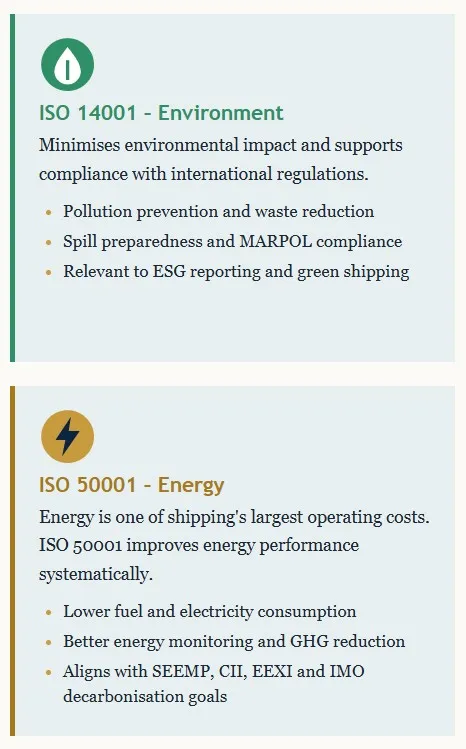
ISO 14001 – Environment
Minimises environmental impact and supports compliance with international regulations.
Minimises environmental impact and supports compliance with international regulations.
- Pollution prevention and waste reduction
- Spill preparedness and MARPOL compliance
- Relevant to ESG reporting and green shipping
ISO 45001 – Health & Safety
Prevents injuries, accidents and occupational illness.
Prevents injuries, accidents and occupational illness.
- Stronger safety culture, fewer Lost Time Injuries
- Better hazard identification and risk assessment
- Lower insurance and compensation costs
ISO 50001 – Energy
Energy is one of shipping’s largest operating costs. ISO 50001 improves energy performance systematically.
Energy is one of shipping’s largest operating costs. ISO 50001 improves energy performance systematically.
- Lower fuel and electricity consumption
- Better energy monitoring and GHG reduction
- Aligns with SEEMP, CII, EEXI and IMO decarbonisation goals
These standards suit ship management companies, training institutes, survey companies, marine consultants, shipyards, offshore operators, ports and logistics companies.
.
Why internal auditor training is essential
An Internal Auditor verifies that the management system is effectively implemented, properly documented, compliant with the applicable standards, and continuously improving. Internal audits let an organisation find problems before they become major non-conformities in an external audit or inspection.

.
Why combine ISO auditing with ISM, ISPS & MLC?
The most effective maritime auditors understand both IMO requirements and ISO standards. Together they cover every aspect of maritime operations.
ISM Code
Safety management system, risk management, emergency preparedness, continuous improvement.
ISPS Code
Ship security, port interface, security risk assessment, security drills.
MLC 2006
Crew welfare, living conditions, working hours, employment standards.
ISO standards
Quality, environment, occupational health & safety, energy management and organisational excellence.
.
Career advantages for maritime professionals
Holding both a maritime internal auditor and an ISO internal auditor qualification opens doors to roles such as:

It also strengthens your profile with ship management companies, oil majors, offshore operators, classification societies, flag administrations, marine training institutes, ports & terminals, shipyards and marine consultancy firms.
.
Why choose Pioneer Maritime Training Institute?
Our Integrated Internal Auditor Programme combines practical maritime expertise with internationally recognised management system auditing principles. Participants learn:
- ISO 19011:2018 auditing guidelines
- Risk-based thinking
- Audit planning
- Interview techniques
- Evidence collection
- Root cause analysis
- Non-conformity reporting
- Corrective action verification
- Practical maritime case studies
- ISM Code
- ISPS Code
- MLC 2006
- ISO 9001
- ISO 14001
- ISO 45001
- ISO 50001
Training is delivered by experienced Master Mariners, Marine Superintendents, Lead Auditors and Maritime Consultants.
Conclusion
Maritime compliance now reaches well beyond statutory minimums. Organisations are expected to show excellence in quality, environmental stewardship, occupational health and safety, and energy performance.
By combining ISO 9001, ISO 14001, ISO 45001 and ISO 50001 with expertise in the ISM Code, ISPS Code and MLC 2006, you become a versatile auditor who drives continual improvement, ensures compliance and adds strategic value, whether you aim to be a Marine Superintendent, QHSE Manager, DPA, Vetting Superintendent, Internal Auditor or Marine Consultant.
Take the next step in your maritime career. Become an Integrated Management System Internal Auditor and help shape safer, smarter and more sustainable maritime operations.