Pioneer Group

Unit No - 942, Tower B2, Spaze I-Tech Park, Sohna Road, Gurgaon

Blog

Home / Blogs / HOOGLY INCIDENT ANALYSIS

Blog

Home / Blogs / HOOGLY INCIDENT ANALYSIS

HOOGLY INCIDENT ANALYSIS

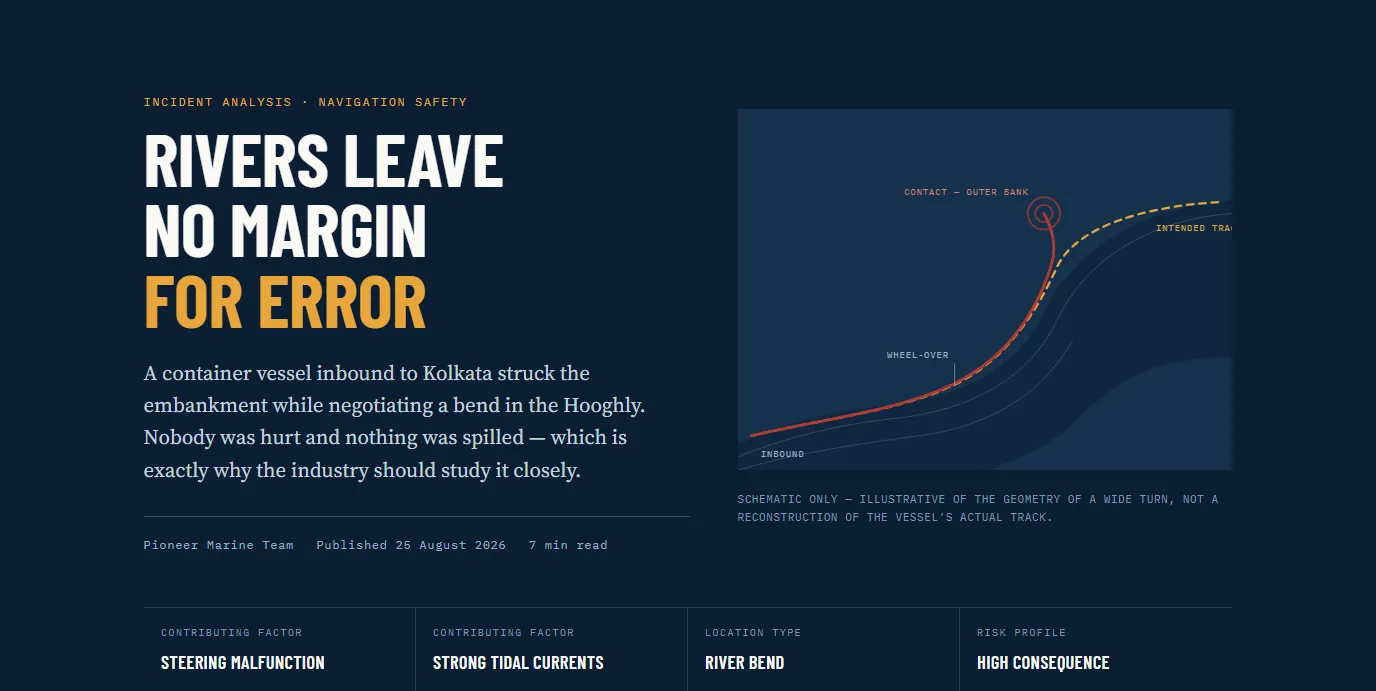
A container vessel inbound to Kolkata struck the embankment while negotiating a bend in the Hooghly. Nobody was hurt and nothing was spilled — which is exactly why the industry should study it closely.
On 12 August 2026, a container vessel inbound to Kolkata made contact with the river embankment while negotiating a bend in the Hooghly River. Strong tidal currents and a suspected steering malfunction were identified as contributing factors. There were no injuries and no pollution, and the vessel was refloated the following day.

By the usual measures, that is a good outcome. No casualties, no oil on the water, no cargo lost, a hull that floated off on the next tide. In a vetting report it may end up as a short line item. In the industry’s collective memory it may not register at all.

That is the problem. The incidents that teach the most are rarely the ones that make headlines — they are the near-misses and low-consequence contacts where every failure in the chain was present, but the last one happened to be forgiving. This one deserves a longer look.
DATE 12 August 2026

VESSEL Container vessel, inbound to Kolkata

LOCATION Bend in the Hooghly River, under pilotage

EVENT Contact with the river embankment during the turn

CONTRIBUTING FACTORS Strong tidal currents; suspected steering malfunction

OUTCOME No injuries. No pollution. Vessel refloated the following day.

Why the Hooghly punishes hesitation

The approach to Kolkata is one of the more demanding river passages a deep-sea vessel will make. It is a long stretch of pilotage through a shifting, silt-laden channel where the navigable water is defined less by the shoreline than by the sandbars beneath it. The banks move. The channel moves with them. Tidal streams run hard, and in the bends they do not run parallel to the intended track — they set across it.

That cross-set is the part crews underestimate. In open water, a current is a correction: a few degrees of drift angle, adjusted and forgotten. In a bend in a confined channel, the same current becomes a force acting on the vessel’s pivot point at precisely the moment the hull is already swinging. The margin between the intended track and the bank is measured in ship-widths, and the time available to notice a developing problem is measured in seconds, not minutes.

Add a large container vessel — high windage, significant inertia, a pivot point that shifts as she gathers or loses way — and the geometry becomes unforgiving. A turn started slightly late, or a rudder that responds slightly slower than expected, does not produce a small error. It produces a track that runs wide onto the outer bank.


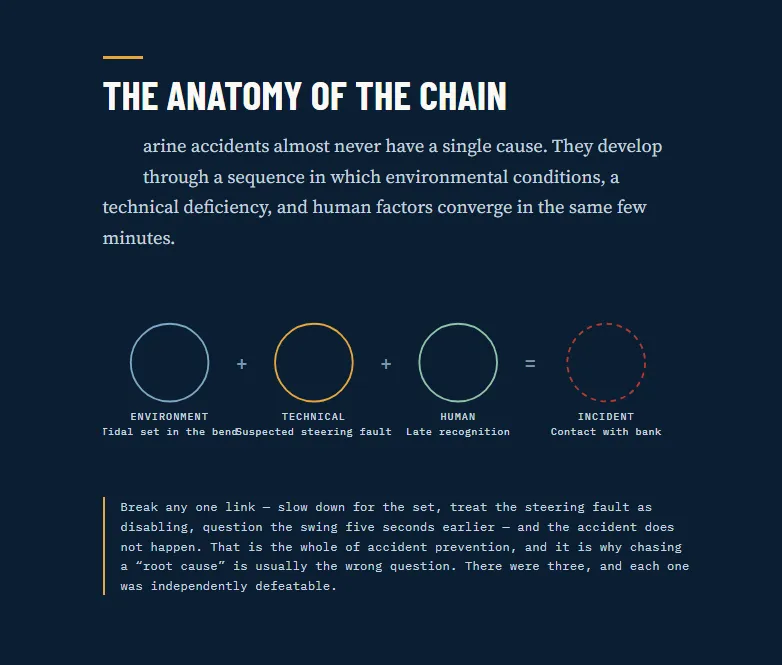
Most accidents are not caused by one failure.

They are caused by three that arrive together.

Everything above is context, not cause. What actually put the vessel on the embankment was a combination — and it is the combination, rather than any single item on the list, that carries the lesson.

FIVE LESSONS WORTH CARRYING TO THE BRIDGE

These are not new. That is the point — the same findings recur across investigation reports year after year, which suggests the industry knows them and does not consistently apply them.
An intermittent steering fault is not a defect to be monitored — it is a loss of the vessel’s primary means of avoiding an accident, and it should be treated as one. If a steering or propulsion anomaly appears before entering pilotage waters, the correct response is a documented risk assessment and a decision to delay, anchor, or take additional tug support, made before the vessel is committed to a channel where there is nowhere to go. Once the vessel is in the bend, that option no longer exists.
High-risk river navigation is not a task the pilot performs while the bridge team watches. It requires continuous, explicit exchange between the Master, Pilot, Officer of the Watch, Helmsman, and Engine Room — a shared mental model of what should happen next, so that a deviation is recognised as a deviation. The most valuable question on any bridge is a junior officer saying “she’s not coming round” twenty seconds before it becomes obvious. That only happens where the culture makes it safe and the briefing made it expected.
Strong cross-currents and tidal streams can overpower a vessel quickly when speed, wheel-over position, or helm response are not precisely managed. Tidal windows in rivers like the Hooghly are calculated for a reason, and the assumptions behind them — expected speed, expected rate of turn, expected response — need to be re-validated as the vessel actually performs, not just once during planning.
A route line on an ECDIS is not a passage plan. A passage plan for confined waters specifies wheel-over positions and expected rates of turn, abort points and the last point at which aborting is still possible, tug utilisation, under-keel clearance calculations, current predictions for the actual transit time, and the contingency actions if the vessel is not where the plan says she should be. All of it belongs in the Master–Pilot exchange — not as a form to be signed, but as a conversation in which both parties confirm they hold the same plan.
Steering gear, propulsion response, radars, ECDIS settings and alarms, and internal communications must all be verified before entering pilotage waters, where reaction time is measured in seconds. Pre-arrival testing is a regulatory requirement, but the deeper purpose is to establish a baseline: you cannot recognise abnormal response if nobody confirmed what normal looked like an hour ago.
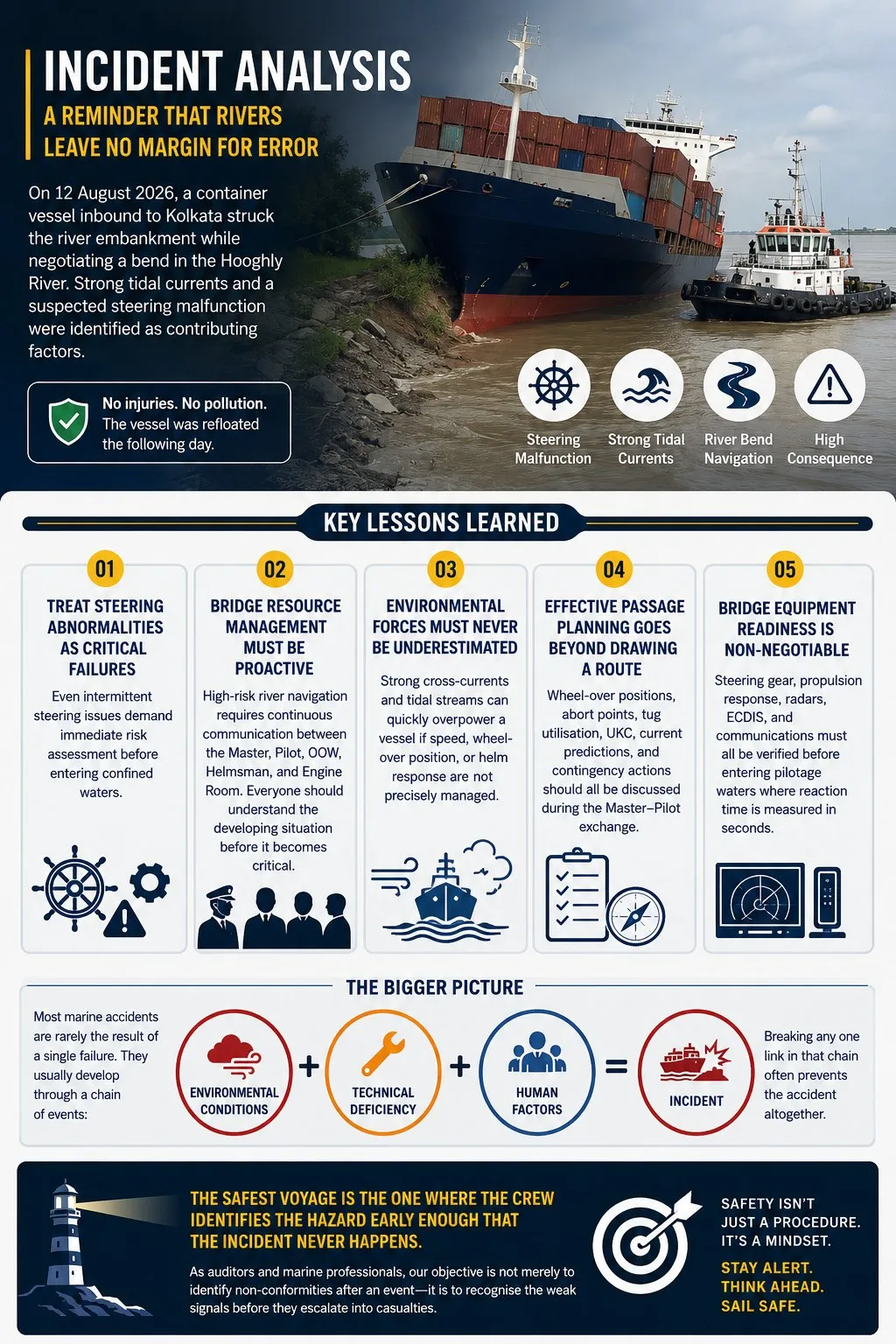
Summary graphic: Incident Analysis. A container vessel inbound to Kolkata struck the river embankment while negotiating a bend in the Hooghly River on 12 August 2026. Contributing factors: steering malfunction, strong tidal currents, river bend navigation, high consequence. No injuries, no pollution; the vessel was refloated the following day. Five key lessons: treat steering abnormalities as critical failures; bridge resource management must be proactive; environmental forces must never be underestimated; effective passage planning goes beyond drawing a route; bridge equipment readiness is non-negotiable. Environmental conditions plus technical deficiency plus human factors equals incident.

FROM INVESTIGATING ACCIDENTS TO READING WEAK SIGNALS

The industry is competent at investigation. Reports are thorough, causal chains are mapped, and corrective actions are issued. But investigation is, by definition, a response to something that has already cost somebody something.

The higher-value discipline is recognising weak signals — the small, easily rationalised indications that appear before an incident and that nobody escalates because individually none of them seems serious enough.

WEAK SIGNALS WORTH ESCALATING

For ship managers and vetting professionals, this is the shift that SIRE 2.0 was designed to encourage: an assessment model weighted toward how a crew actually manages risk in the moment, rather than whether a procedure exists in a manual. Hardware and process still matter. But a bridge team that recognises a developing situation early will outperform a compliant one that does not.